
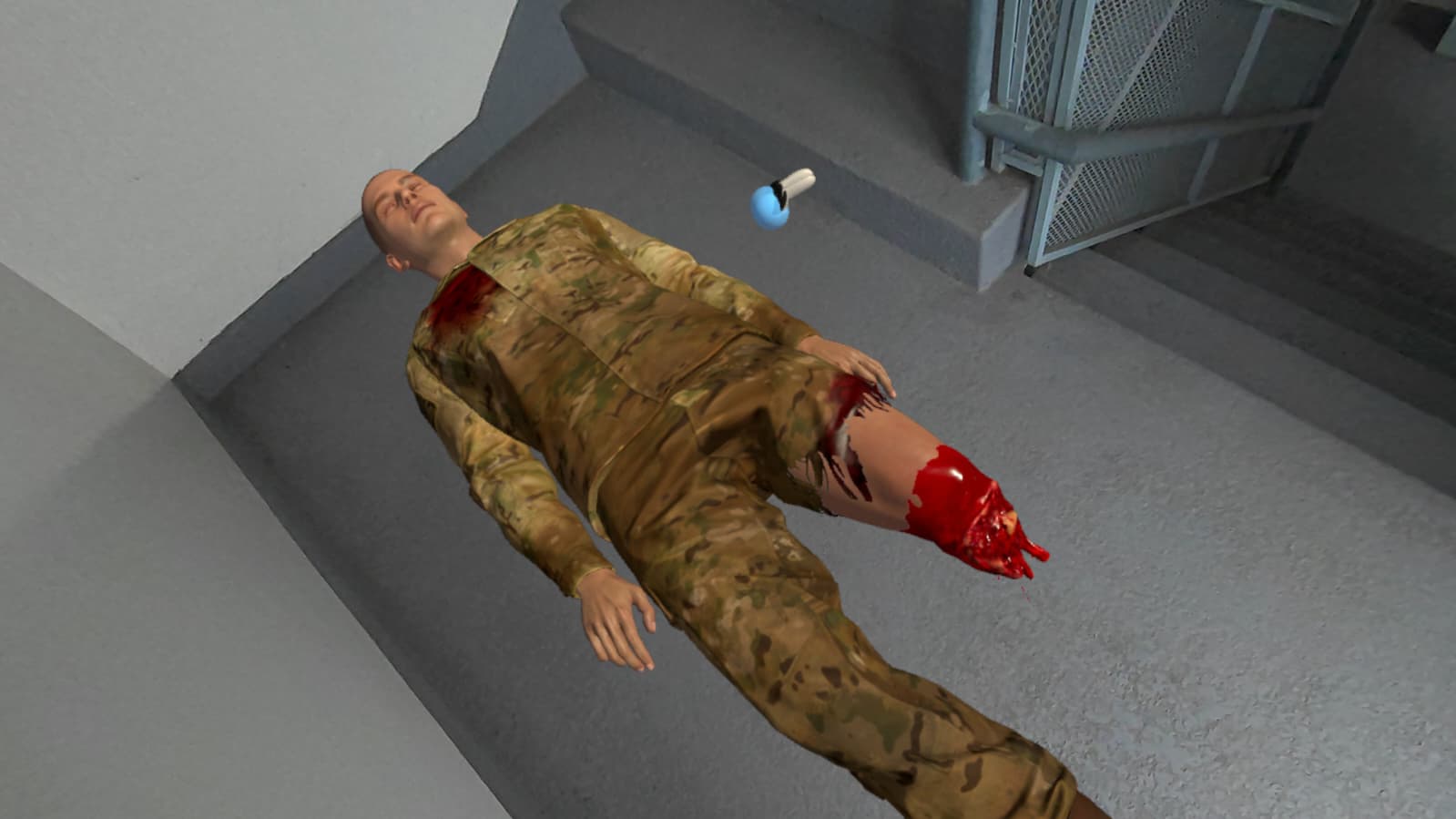
You are providing care near the frontline. Once you have performed all life-saving interventions indicated for this phase of care, you can select [Disposition] in the tablet and select [Medical Evacuation to Higher Level of Care, Return to Duty, or Pronounce Dead], which will end your case. Note, unfortunately, just like in real life, it is not possible to save all patients. The treatment policy for THIS TRAINING ONLY is to pronounce a patient dead if there is no pulse for more than two minutes. In this combat theater, it is not possible to transfer a patient who requires active cardiopulmonary resuscitation.
Patient Communication
Patient: Can you tell me your name?
Response: I can't really remember, and its hard to talk
Location: Head
Patient: Do you remember what happened?
Response: I think there was explosion. Then gunfire.
Location: Head
Patient: Do you feel any pain?
Response: Yes my chest and head are killing me
Location: Head
Patient: Do you have any medical problems?
Response: No, I don’t have any medical problems I know of
Location: Head
Patient: Do you have any allergies?
Response: No, I don't have any allergies I know of
Location: Head
Patient: Do you take any medications?
Response: No, I don't take any medications
Location: Head
Patient: Are you feeling dizzy or confused?
Response: A little it’s getting hard to focus.
Location: Head
Patient: Are you having trouble breathing?
Response: I think the pain is making it hard to breath
Location: Head
Patient: Can you see clearly?
Response: Everything seems a little blurry
Location: Head
Patient: Do you feel any swelling in your throat?
Response: No, I think its okay
Location: Head
Patient: Are your lips or tongue swollen?
Response: No, I think they are doing okay
Location: Head
Patient: Is your voice hoarse or different?
Response: It seems like it is about the same as usual
Location: Head
Patient: Any numbness or tingling?
Response: No. Everything feels normal.
Location: Right Arm
Patient: Any numbness or tingling?
Response: No. Everything feels normal.
Location: Left Arm
Patient: Any numbness or tingling?
Response: No. Everything feels normal.
Location: Right Leg
Patient: Any numbness or tingling?
Response: No. Everything feels normal.
Location: Left Leg
Scoring Details
PPE: Blue Gloves (right side)
PPE: Blue Gloves (left side)
PPE: Blue Gloves (right side)
PPE: Blue Gloves (left side)
Exam: Assessment: Remove the patient's shirt
Exam: Assessment: Remove the patient's underpants
Exam: Assessment: Remove the patient clothing around left leg
Exam: Assessment: Remove the patient clothing around right leg
Exam: Assessment: Roll the patient over
Exam: Assessment: Roll the patient back
Exam: Assessment: Roll the patient over
Exam: Assessment: Roll the patient back
Exam: Assessment: Remove the patient clothing around left leg
Exam: Assessment: Remove the patient clothing around right leg
Exam: Assessment: Remove the patient's shirt
Exam: Assessment: Remove the patient's underpants
Roll patient into recovery position
Blood Sweep (right chest, front) (Gunshot Wound Chest Right)
Blood Sweep (right chest, back) (Gunshot Wound Back Right)
Blood Sweep (right lower leg) (Deep Wound Leg Right)
Blood Sweep (left lower thigh) (Left Leg Ampute)
Blood Sweep (right lower thigh) (Right Leg Ampute)
Blood Sweep (left upper arm) (Left Arm Ampute / Shrapnel Arm Left)
Blood Sweep (right upper arm) (Right Arm Ampute / Shrapnel Arm Right)
Blood Sweep (left arm) (Deep Wound Arm Left)
Blood Sweep (right arm) (Deep Wound Arm Right)
Blood Sweep (left lower leg) (Deep Wound Leg Left)
Blood Sweep (left upper thigh) (Left Leg Ampute / Shrapnel Leg Left)
Blood Sweep (right upper thigh) (Open Fracture / Open Fracture Blood / Shrapnel Leg Right)
Blood Sweep (left chest, front) (Gunshot Wound Chest Left)
Blood Sweep (stomach) (Shrapnel)
Blood Sweep (groin)
Massive Hemorrhage: Place Tourniquet on Left Upper Leg
Place bandage on the right lower leg (deep wound)
Fill right leg wound with wound packaging
Apply pressure to right leg
Place bandage on the right lower leg (deep wound)
Fill right leg wound with wound packaging
Apply pressure to right leg
Hold Hands Over Bleeding Injury
Apply pressure to right leg
Exam: Ask patient
Airway: Jaw thrust maneuver
Listen for breathing
Breathing: Needle Decompression right side placement
Place Chest Seal Front Right
Place Chest Seal Back Right
Exam: Assessment: Check Carotid Pulse Right
Exam: Assessment: Check Carotid Pulse Right
Exam: Assessment: Check Carotid Pulse Left
Exam: Assesment: Check Radial Pulse Right
Exam: Assesment: Check Radial Pulse Left
Exam: Assesment: Check Femoral Pulse Right
Exam: Assesment: Check Femoral Pulse Left
Exam: Assesment: Check Pedial Pulse Right
Exam: Assesment: Check Pedial Pulse Left
Lift right eyelid
Lift left eyelid
Hypothermia Management: Place Blanket
Hypothermia Management: Put Back All Clothes
Exam: Ask patient
Exam: Ask patient to move right leg
Exam: Ask patient to move left leg
Exam: Ask patient to move right arm
Exam: Ask patient to move left arm
Exam: Assessment: Palpate Head (Right)
Exam: Assessment: Palpate Thorax (Left)
Exam: Assessment: Palpate Lower Left Abdomen
Exam: Assessment: Palpate Lower Right Abdomen
Exam: Assessment: Palpate Upper Left Abdomen
Exam: Assessment: Palpate Lower Right Abdomen
Exam: Assessment: Palpate Right Arm
Exam: Assessment: Palpate Right Palm
Exam: Assessment: Palpate Left Arm
Exam: Assessment: Palpate Left Palm
Exam: Assessment: Palpate Right Leg (Proximal)
Exam: Assessment: Palpate Right Leg (Medial)
Exam: Assessment: Palpate Right Leg (Distal)
Exam: Assessment: Palpate Left Leg (Proximal)
Exam: Assessment: Palpate Left Leg (Medial)
Exam: Assessment: Palpate Left Leg (Distal)
Exam: Assessment: Palpate along back
Exam: Assessment: Palpate Head (Left)
Exam: Assessment: Palpate Head (Left)
Exam: Assessment: Palpate Trachea
Exam: Assessment: Palpate Jaw
Exam: Assessment: Complete TCCC card
Complete NATO Field card
Patient disposition: Medical Evacuation