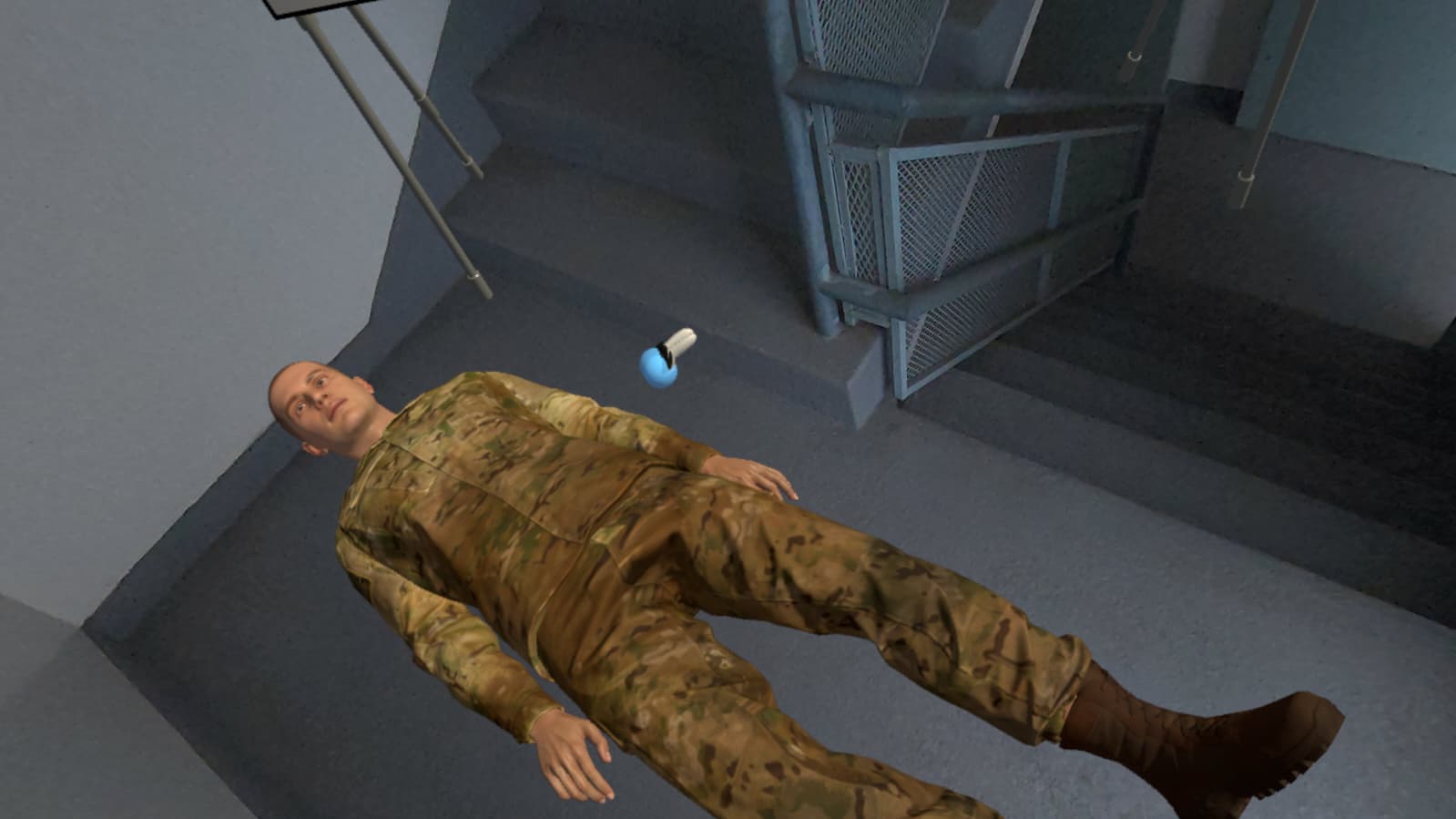
The patient was injured in a blast from a drone attack about 30 minutes ago and other soldiers dragged them to your location. You already washed your hands, put on your gloves, and did a search for massive hemorrhage, which was normal. The patient's airway is clear. You assessed the patient’s chest and found two open chest wounds. You placed chest seals on both. Next, assess for signs of a tension pneumothorax. What do you find on your exam? Press and hold [B] to proceed to the next step.
If you identified that the patient has evidence of a tension pneumothorax on the right side, good job! The patient has less chest rise and fall on the right side, tracheal deviation to the left (windpipe pushed to the patient's left), and jugular vein distension (neck veins are enlarged). How do you treat this life threatening injury?
If you said assess the Chest Seals and possibly a Needle Decompression Catheter placement (NDC), good job! First you would assess the Chest Seals to see if they had built up ‘air’ that needed to be released (burped). If it is present then just releasing that air might briefly correct the tension pneumothorax. Look at both chest seals closely. Is there air to be released?
In this patient, there is no air built up to release. So, placing an NDC is the next step. Next, open your Combat Life Saver Pack and find a large needle labeled Needle Decompression Catheter (NDC) and pick it up. For this example, you will use a 10 gauge, 3 ¼ inch needle. Another option when you are in the field is a 14 gauge, 3 ¼ inch needle.
With the NDC in your hand, you should see two batches of highlighted areas on the patient's chest. These are the two general regions in which NDC can be performed, but note that only ONE location in each batch is correct. Next, we will identify the correct locations to place the NDC.
The first entry point we will find is the fifth intercostal space in the anterior axillary line on the right side. The fifth intercostal space can be estimated right around the ‘nipple’ line in men (or) just above the inframammary crease in women. The anterior axillary line is an imaginary line drawn from the ‘front’ of the armpit straight down the patient. Next, do your best to identify this site and place the NDC. If you do not get the correct location the first time, try again until you find the correct location.
Informational Step: Broadly, a location that is more towards the middle of the patient’s chest could hit the patient's heart. A location too low (towards the patient's feet) could hit the patient's liver, spleen, or intestines. The zone of safety is high and more towards the side of the patient (towards the armpit). With a small exception near the front of the shoulder where a big blood vessel runs.
Informational step: In real life, you would use your fingers to palpate or feel the rib, then you would insert the needle just over the rib to avoid any blood vessels or nerves that run underneath ribs. You would insert the needle just over the top of a rib inserting it to the hub. You would leave the needle in for 5 to 10 seconds, then you would remove the needle leaving the catheter in place. Removing the needle is not possible in the simulator at this time
Next, assess the patients for signs of a tension pneumothorax. What do you find on your exam?
If you said the patient looks better, good job! The patient’s right chest has started to rise and fall more evenly with the left. Also, the patient's heart rate is starting to improve. For the sake of learning, we will say the patient starts to get worse again. What would you do?
If you said place another NDC, good job! For learning we will place an NDC at the second intercostal space and midclavicular line.
You never want to place the needle closer to the middle of the chest than the patient's nipple line. You also do not want to go too close to the shoulder. In real life you would palpate for the second intercostal space and place the needle just over the 3rd rib. Next, do your best to identify this site and place the NDC.
Informational Step: NDC placement is a temporizing measure. The catheters can get occluded or fall out, and the patient will ultimately need a chest tube. If evidence of a tension pneumothorax reoccurs then place another NDC at the same site.
This concludes your scenario. Next, open your tablet [X], select the disposition tab, and select Medical Evacuation.