033 ASM

The primary learning objective is to review the fact that not every patient can be saved. Even if we do our best – sometimes a patient’s injuries are just too severe. The estimated time to complete this scenario is 5 minutes.

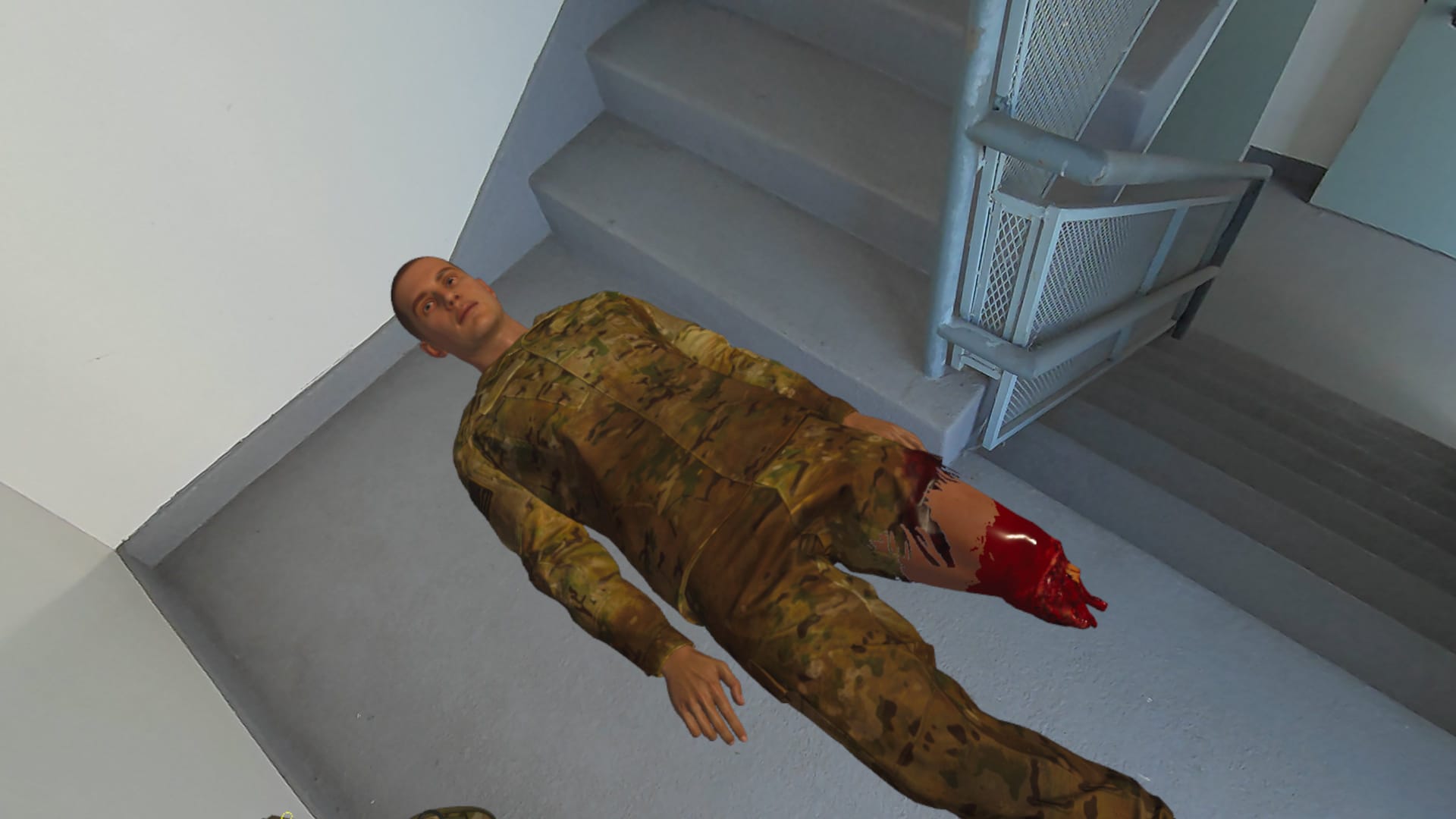
You may recognize this patient looks similar to PVT Danny Rivers, who you started taking care of in Care Under Fire where you identified a LEFT LOWER EXTREMITY massive hemorrhage and placed a tourniquet on the left leg and then moved the patient to safety. Next you performed a blood sweep which was normal. You then identified an airway obstruction and implemented a head-tilt-chin lift. Then you performed a respiratory assessment which was unremarkable. Your circulation assessment revealed suspected shock from internal bleeding. You managed hypothermia by replacing the patient’s clothing and gear. The patient had a possible head injury and a left side eye injury, but did not appear to have any fracture or burn injuries. You already have personal protective equipment (gloves) on. Additionally, you immediately activated a medical evacuation, but they cannot make it to your location, and it will be at least 40 minutes until they arrive. And there is no clear route for you to reach individuals with more medical skills or supplies.

For this scenario, the severity of the patient’s injuries have been increased, and the patient is not saveable.

Initially, the casualty was near a drone explosion. This scenario occurs in the Tactical Evacuation Care Phase and covers elements after the initial MARCH, head injury, eye injury, fracture, and burn portion(s) of care. Equipment Available: Individualized First Aid Kit (IFAK) U.S Version (x2). Evacuation/Disposition is possible through the tablet. Selecting the patient’s disposition will end the exercise. (This is Scenario 033).

Ongoing Development Disclaimer: In this package wording has not been updated to reflect new functionality to time and date tourniquets or for the non-adhesive burn bandage functionality. Additionally, it is possible other small updates or changes are not reflected in the wording. All grading is set to the current standard described in this package.

Patient Communication

Patient: Hey, I am here to take care of you.
Response: The patient is not responding
Location: Head
Patient: Can you tell me your name?
Response: The patient is not responding
Location: Head
Patient: What happened?
Response: The patient is not responding
Location: Head
Patient: Are you hurting anywhere?
Response: The patient is not responding
Location: Head
Patient: Does your throat hurt or feel tight?
Response: The patient is not responding
Location: Head
Patient: Are you having a hard time breathing?
Response: The patient is not responding
Location: Head
Patient: Does your chest hurt?
Response: The patient is not responding
Location: Head
Patient: Did you pass out (lose consciousness)?
Response: The patient is not responding
Location: Head
Patient: Do you have any numbness or weakness?
Response: The patient is not responding
Location: Head
Patient: Does your head hurt?
Response: The patient is not responding
Location: Head
Patient: Does your neck hurt?
Response: The patient is not responding
Location: Head
Patient: Does your back hurt?
Response: The patient is not responding
Location: Head
Patient: Does your abdomen hurt?
Response: The patient is not responding
Location: Head
Patient: Do you have any allergies?
Response: The patient is not responding
Location: Head
Patient: Do you take any medications?
Response: The patient is not responding
Location: Head
Patient: Do you have any medical problems?
Response: The patient is not responding
Location: Head
Patient: Have you ever had any surgeries?
Response: The patient is not responding
Location: Head
Patient: When did you last eat or drink something?
Response: The patient is not responding
Location: Head
Patient: Do you smoke, drink, or use recreational drugs?
Response: The patient is not responding
Location: Head
Patient: I am here with you.
Response: The patient is not responding
Location: Head

Guided Steps

The goal of this scenario is to highlight the fact that even if you do everything ‘right,’ you cannot save every casualty. You may recognize that this patient looks identical to one you have cared for several times (Private Danny Rivers). This patient’s injuries are the same as Private Danny Rivers’, but this patient's injuries are more severe, making it ‘impossible’ to save this patient’s life.
You started caring for this patient eight minutes ago. You placed a tourniquet on his left leg, moved the patient to a more secure location, put on gloves, completed a blood sweep, performed a head-tilt-chin lift, assessed respirations, identified that the patient was in shock, called for help (estimated arrival 40 minutes), replaced clothing, identified a possible head injury, and a left eye injury.
The patient cannot be saved and will not survive until further help arrives. While this is sad and something we try to minimize, it is a fact. Learn, train, and practice these skills so that if you are ever in a situation like this, you can feel confident you did everything you could to save a life.
Even though there is nothing else you can do to save this person, and the patient does not seem to be responding, you can still tell the patient you are here to take care of them.
Informational Step: In addition to communicating with the patient, you can try to do things like get them a blanket, prop their head up, or do other comforting things to help be there for them in their final moments.
Next, check one of the patient’s pulse locations (neck, wrist, groin, foot), and keep your hand there until it goes to zero and the patient stops breathing (it is possible the patient has already died). While different theaters have different policies about providing CPR for trauma patients in the field, most do not support providing CPR in a combat zone, as the odds of saving this patient (unless medical care is very close) are extremely low.
It is critical to realize that in this scenario, you (and your team) did everything you could, and this patient's death is not your fault. Thank you for doing what you do, and for completing this training to help save as many people as you can.
Next, open your tablet [X], select the disposition tab, and select Pronounce Dead to end this scenario. This concludes this training scenario on ‘Not Every Patient Can Be Saved’. After reviewing the feedback panel, exit this simulation and select scenario 034 to continue. 

Scenario Details

Scenario Package
TCCC Tier 1 Curriculum
Learner type
  • militaryMedic
Patient severity at start
Critical
Patient severity overall
Critical
Duration to complete
<5 minutes
Scenario difficulty
Standard
Environment
POI
Equipment
  • Bandage
  • Combat Application Tourniquet (1)
  • Combat Application Tourniquet (2)
  • Trauma Shears
  • Blanket
  • FoilBlanket
  • Nasopharyngeal airway
  • Chest Seal Package
  • Packing Gauze
  • Gloves
  • Eye Guard
  • Non-Adherent Dressing
  • Medication Pouch
  • Radio
  • Marker
  • Triage Tag (Minimal)
Available medications
  • Acetaminophen Pills
  • Moxifloxacin 1 g
  • Meloxicam 15mg
Injury type
  • Abdominal internal bleeding
  • Amputated left leg at knee
  • Bruise behind right ear
  • Eye cornea trauma, left side
Pathologies
  • internal hemorrhage, vena cava
  • airway obstruction
  • external hemorrhage, left leg
Scoring details
  • Check Pulse
  • Communicate to patient
  • Disposition