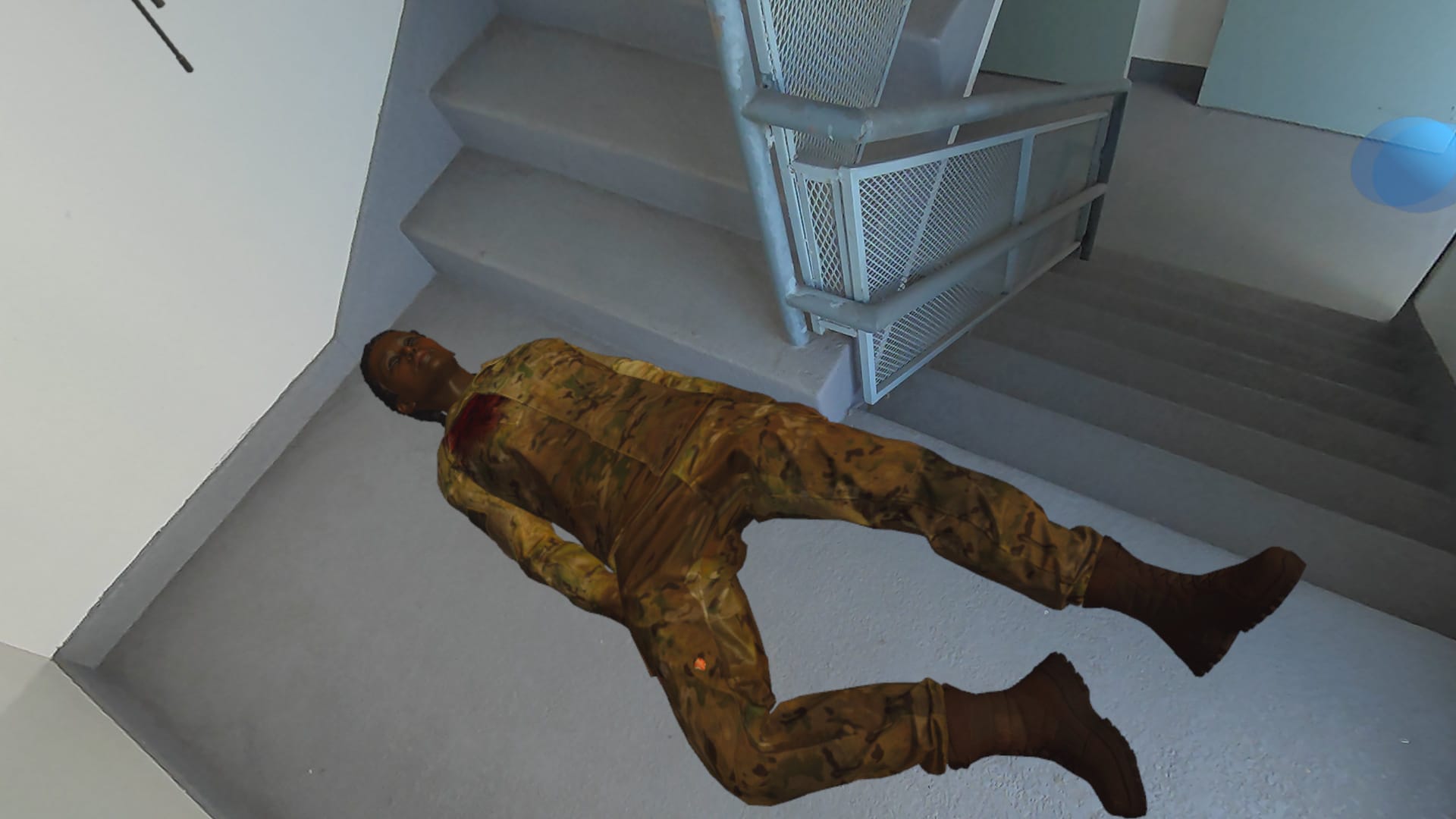
032 ASM

Documentation and communication protocols in TCCC – Tier 1 – You are in a SAFE and SECURE location – The primary learning objective is to practice TCCC documentation and communication protocols after completing the core M A R C H algorithm and the extended head injury, eye injury, fracture, and burn management phase. The estimated time to complete this scenario is 5 minutes.
You first started taking care of this patient in Care Under Fire, you moved the patient to safety, and no massive bleeding was identified on blood sweep. You then identified an airway obstruction, that improved with a head-tilt-chin lift. Then you performed a respiratory assessment which revealed a suspected tension pneumothorax. Next, during the circulation phase you evaluated the patient and felt they were in shock, likely secondary to the tension pneumothorax. During the hypothermia phase you put the patient’s clothes and gear back on. The patient had a right leg fracture, a possible head injury, but no evidence of penetrating eye injuries or burns. You already have personal protective equipment (gloves) on. No other interventions have been performed.
Initially, the casualty was near a drone explosion that occurred 12 minutes ago (it has been one minute since you last saw the patient). This scenario occurs in the Tactical Evacuation Care Phase and covers elements after the initial MARCH, head injury, eye injury, fracture, and burn portion(s) of care. Equipment Available: Individualized First Aid Kit (IFAK) U.S Version (x2). Evacuation/Disposition is possible through the tablet. Selecting the patient’s disposition will end the exercise. (This is Scenario 032).

Dynamic Physiology Disclaimer:
To obtain the most accurate and effective training experience, we recommend completing each scenario in one uninterrupted session. The virtual patients used in this training are powered by highly realistic physiological models that continuously adjust vital signs and overall condition. The scenarios have been modified to give you time to review instructional materials, and you will not lose points for delays in scenarios with instructional content. However, it is still possible that, depending on your completion pace, the scenario may not progress in perfect alignment with the guided prompts, and for critically injured patients, even moderate delays may result in deterioration or death before the scenario concludes. This is not meant to indicate you did not perform well; rather, it is because of how the high-fidelity engine performs.

Ongoing Development Disclaimer: In this package wording has not been updated to reflect new functionality to time and date tourniquets or for the non-adhesive burn bandage functionality. Additionally, it is possible other small updates or changes are not reflected in the wording. All grading is set to the current standard described in this package.

Patient Communication

Patient: Hey, I am here to take care of you.
Response: The patient isn't able to speak, and has noisy breathing
Location: Head
Patient: Can you tell me your name?
Response: The patient isn't able to speak, and has noisy breathing
Location: Head
Patient: What happened?
Response: The patient isn't able to speak, and has noisy breathing
Location: Head
Patient: Are you hurting anywhere?
Response: The patient isn't able to speak, and has noisy breathing
Location: Head
Patient: Does your throat hurt or feel tight?
Response: The patient isn't able to speak, and has noisy breathing
Location: Head
Patient: Are you having a hard time breathing?
Response: The patient isn't able to speak, and has noisy breathing
Location: Head
Patient: Does your chest hurt?
Response: The patient isn't able to speak, and has noisy breathing
Location: Head
Patient: Did you pass out (lose consciousness)?
Response: The patient isn't able to speak, and has noisy breathing
Location: Head
Patient: Do you have any numbness or weakness?
Response: The patient isn't able to speak, and has noisy breathing
Location: Head
Patient: Does your head hurt?
Response: The patient isn't able to speak, and has noisy breathing
Location: Head
Patient: Does your neck hurt?
Response: The patient isn't able to speak, and has noisy breathing
Location: Head
Patient: Does your back hurt?
Response: The patient isn't able to speak, and has noisy breathing
Location: Head
Patient: Does your abdomen hurt?
Response: The patient isn't able to speak, and has noisy breathing
Location: Head
Patient: Do you have any allergies?
Response: The patient isn't able to speak, and has noisy breathing
Location: Head
Patient: Do you take any medications?
Response: The patient isn't able to speak, and has noisy breathing
Location: Head
Patient: Do you have any medical problems?
Response: The patient isn't able to speak, and has noisy breathing
Location: Head
Patient: Have you ever had any surgeries?
Response: The patient isn't able to speak, and has noisy breathing
Location: Head
Patient: When did you last eat or drink something?
Response: The patient isn't able to speak, and has noisy breathing
Location: Head
Patient: Do you smoke, drink, or use recreational drugs?
Response: The patient isn't able to speak, and has noisy breathing
Location: Head
Patient: Tell the patient what you are going to do.
Response: The patient isn't able to speak, and has noisy breathing
Location: Head
Patient: Tell the patient you are going to take care of them.
Response: The patient isn't able to speak, and has noisy breathing
Location: Head

Guided Steps

You started caring for Private Kiara Mitchell eight minutes ago. You moved the patient to a more secure location, put gloves on, completed a blood sweep, performed a head-tilt-chin lift, identified a tension pneumothorax, recognized that the patient was in shock, called for help (twice) (estimated arrival 3 minutes), replaced clothing, identified a possible head injury, and a right leg fracture.
You are now in the Tactical Field Care phase of TCCC, starting documentation, communicating with the patient, and communicating with command.
Next, use the radio to update your command and the medical team. Can you remember the acronym to help structure this report?
Informational Step: A common way to communicate this information is the MIST report (Mechanism, Injuries, Signs and Symptoms, and Treatments).
Informational Step: Example MIST report for this patient “20-year-old female injured by a drone explosion 10 to 15 minutes ago with an airway obstruction, a tension pneumothorax, worsening shock, a head injury, and a right leg fracture. Her airway seems to be stable with some repositioning, but heart rate and breathing are both really fast and getting worse.”
Radio Response: Received! Excellent job. We are on our way. Continue to watch the patient’s airway. We are bringing equipment for a needle decompression of her chest, a chest seal, a chest tube kit, 2 units of whole blood, airway equipment, and a splint for her leg. Over.
Press [A] to communicate with the patient. Let them know you are there to take care of them and more help is on the way.
Informational Step: Given this patient is getting sicker very quickly (and will likely die from the tension pneumothorax in a few minutes), you could also consider talking with the medic about other heroic life-saving attempts, such as finger thoracostomy (cutting a small hole in the sides of the patient’s chest to let the pressure out). While this seems scary, without it, the patient will likely die.
Next, we need to document the injuries we found and the care we provided to be ready to hand the casualty over. Pick up the TCCC card (also known as Form DD 1380). Please review it and fill it out as best as possible. The card auto-fills in when you pick up the marker from the IFAK and hold the marker towards the TCCC card click on a section. You only need to update one section to get credit for this task. In real life, you would fill it out as completely as possible.
Just as you are getting ready to try performing a finger thoracostomy (with another medic talking you through how to do it on a satellite phone), a Medic runs into the room. Because you told her what was going on, she knows where to start. She quickly inserts a needle decompression catheter into the patient’s chest. A steady whoosh of air is heard, and the patient’s breathing quickly gets better.
Your patient goes on to survive. She is a popular girl from a small town, and three months later, she makes it home to a welcome celebration thrown by her whole community. In some brief remarks to the crowd, she describes how heroic actions on the battlefield saved her life. She was so inspired, she is now going to medical school so she can learn to save others.
This concludes this training scenario on Communication and Documentation in Tactical Field Care. Soon, you will have a chance to care for this patient throughout the entire treatment course without any guidance. Next, open your tablet [X], select the disposition tab, and select Medical Evacuation to end this scenario. After reviewing the feedback panel, exit this simulation and select the following scenario to continue. 

Scenario Details

Scenario Package
TCCC Tier 1 Curriculum
Learner type
  • militaryMedic
Patient severity at start
Serious
Patient severity overall
Serious
Duration to complete
5-10 minutes
Scenario difficulty
Standard
Environment
POI
Equipment
  • Bandage
  • Combat Application Tourniquet (1)
  • Combat Application Tourniquet (2)
  • Trauma Shears
  • Blanket
  • FoilBlanket
  • Nasopharyngeal airway
  • Chest Seal Package
  • Packing Gauze
  • Gloves
  • Eye Guard
  • Non-Adherent Dressing
  • Medication Pouch
  • Radio
  • Marker
  • Triage Tag (Minimal)
Available medications
  • Acetaminophen Pills
  • Moxifloxacin 1 g
  • Meloxicam 15mg
Injury type
  • Deep wound on the right arm
  • Gunshot entry wound, chest right
  • Gunshot exit wound, back right
  • Open fracture of the right thigh with visible bone
  • Tracheal shift to the left side
Pathologies
  • pneumothorax, open, right
  • airway obstruction
Scoring details
  • Documentation
  • Disposition
  • Communicate with leadership
  • Communicate with evacuation team
  • Communicate with patient