
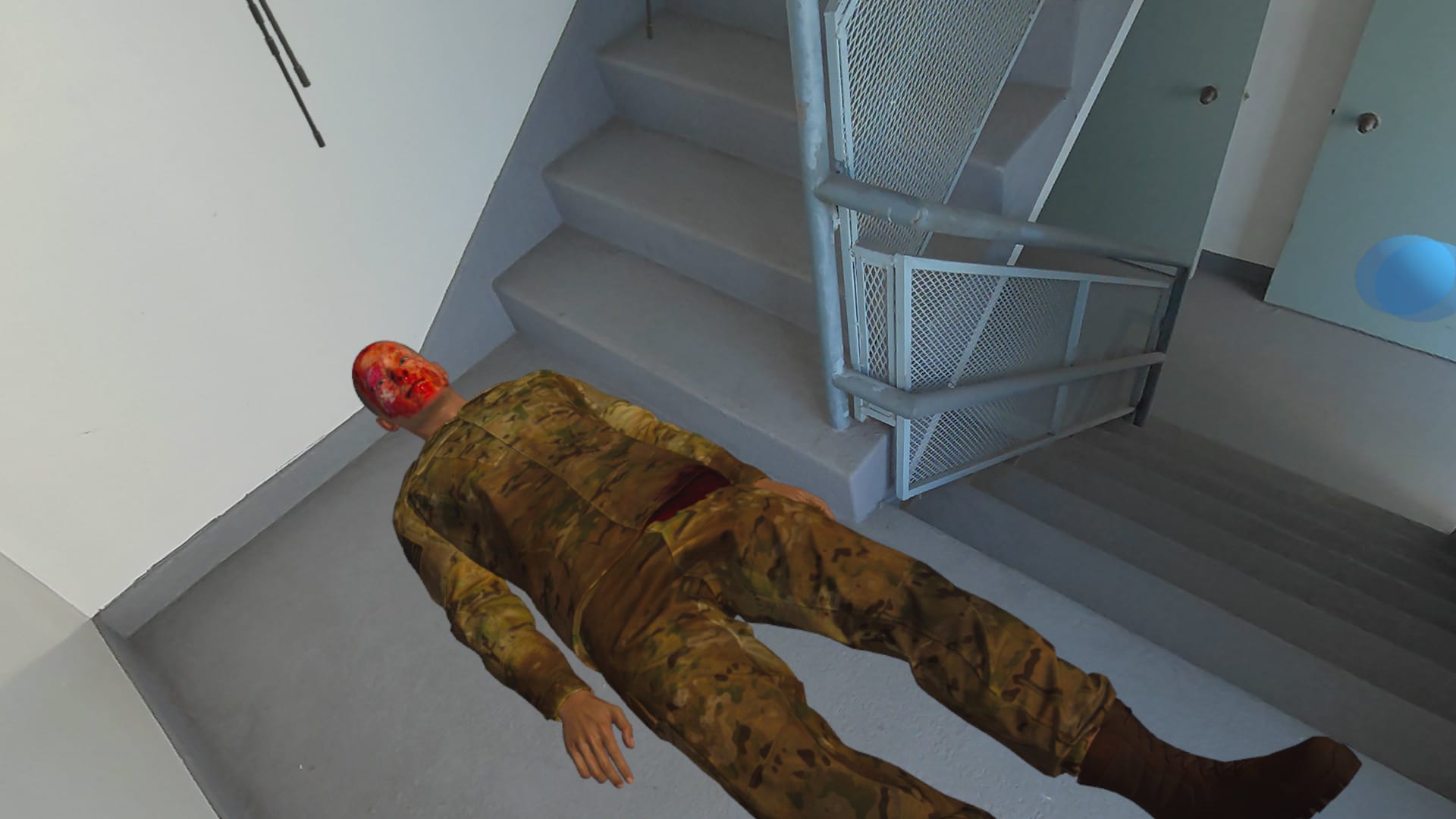
Documentation and communication protocols in TCCC – Tier 1 – You are in a SAFE and SECURE location – The primary learning objective is to practice TCCC documentation and communication protocols after completing the core M A R C H algorithm and the extended head injury, eye injury, fracture, and burn management phase. The estimated time to complete this scenario is 5 minutes.
You first started taking care of Private Luke Hensley in Care Under Fire, you moved the patient to safety, and then you identified massive bleeding from a groin wound and applied pressure, placed wound packing and a pressure bandage. Next, you identified an airway obstruction, which you helped resolve by sitting the patient up. Then you performed a respiratory assessment which was unremarkable. Next, during the circulation phase you evaluated the patient and felt they were relatively stable (not in shock) currently. During the hypothermia phase you put the patient’s clothes and gear back on. The patient had a burn on their arm which was treated, a possible head injury, possible eye injuries, but did not appear to have any fractures. You already have personal protective equipment (gloves) on. No other interventions have been performed.
Initially, the casualty was near a drone explosion that occurred 12 minutes ago (it has been one minute since you last saw the patient). This scenario occurs in the Tactical Evacuation Care Phase and covers elements after the initial MARCH, head injury, eye injury, fracture, and burn portion(s) of care. Equipment Available: Individualized First Aid Kit (IFAK) U.S Version (x2). Evacuation/Disposition is possible through the tablet. Selecting the patient’s disposition will end the exercise. (This is Scenario 031).
Dynamic Physiology Disclaimer:
To obtain the most accurate and effective training experience, we recommend completing each scenario in one uninterrupted session. The virtual patients used in this training are powered by highly realistic physiological models that continuously adjust vital signs and overall condition. The scenarios have been modified to give you time to review instructional materials, and you will not lose points for delays in scenarios with instructional content. However, it is still possible that, depending on your completion pace, the scenario may not progress in perfect alignment with the guided prompts, and for critically injured patients, even moderate delays may result in deterioration or death before the scenario concludes. This is not meant to indicate you did not perform well; rather, it is because of how the high-fidelity engine performs.