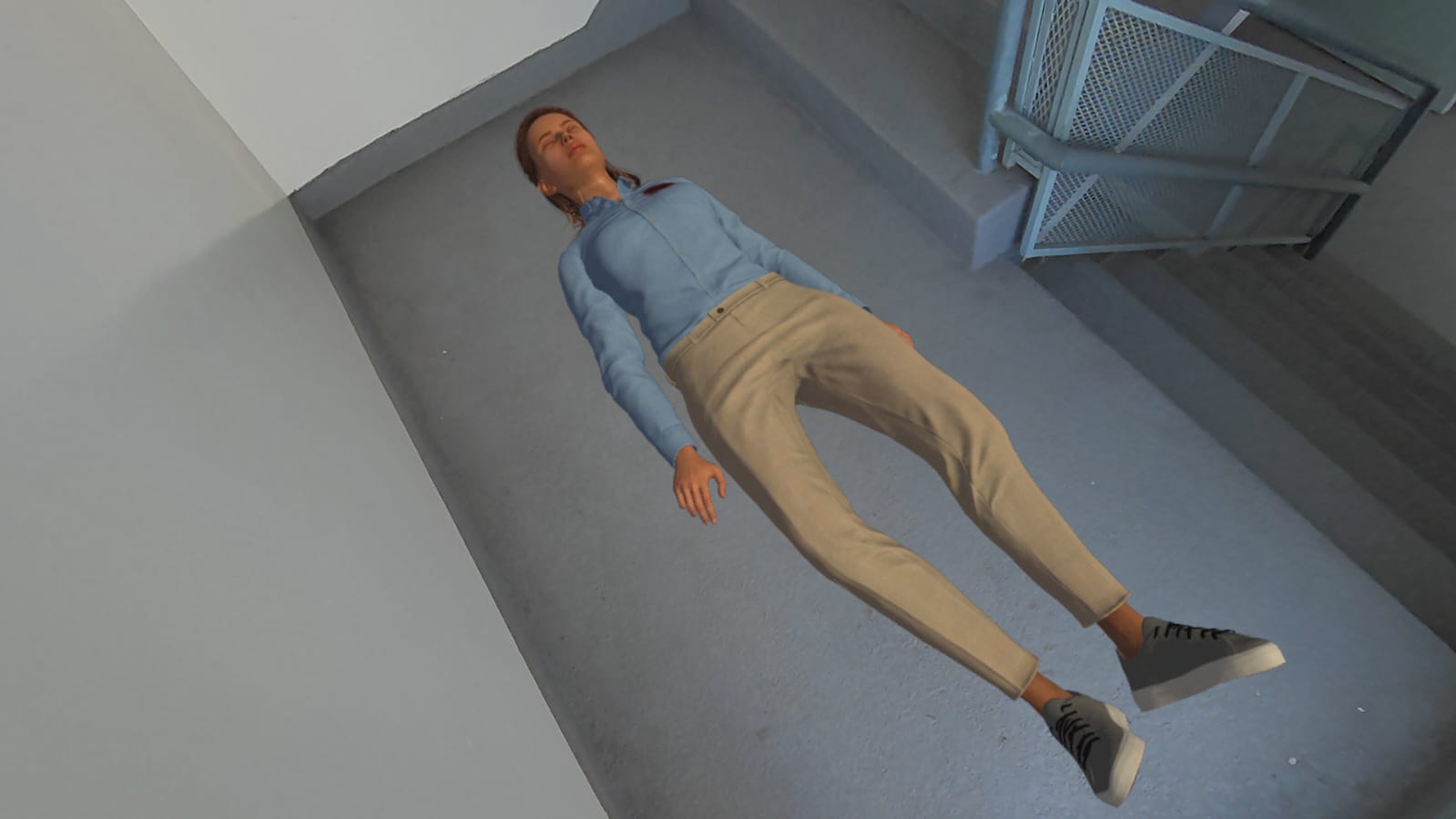
This is your first time taking care of Michaela Price. You are in a secure location. This scenario summarizes Respiratory management in the MARCH Algorithm during TCCC Tactical Field Care. Michaela has a tension pneumothorax (dropped lung under pressure) caused by a penetrating injury to their chest. We will slowly review respiratory assessment and management.
Informational Step: A tension pneumothorax (dropped lung under pressure) can kill a patient in as little as 5 minutes! At the TCCC Tier 1 level, your goal is to be able to tell if a person has this injury (tension pneumothorax). If they do, then you need to immediately get them a Medic who can perform simple treatments that can save their life!
For this scenario, a teammate completed the Massive Hemorrhage and Airway phases of care before your arrival. The patient does not have any bleeding or airway injuries. You already have gloves on.
Informational Step: Next, we will assess if the patient is having a hard time breathing, look for injuries that can cause a tension pneumothorax (wounds on the chest and upper back), and we will look for other signs (clues) of a tension pneumothorax (only one side of the chest moving-unilateral chest rise, windpipe shifted-tracheal deviation, and bigger veins in the neck than normal-jugular venous distention).
First, we will assess the patient’s respiratory effort (how hard they are working to breathe). The quick way to do this is to look at their chest and see if they seem to be breathing fast and labored (like after a workout). Do you think this patient is breathing slow, normal, or fast?
If you said ‘fast,’ good job! This patient is breathing faster than 20 times per minute.
While this sign (clue) does not mean the patient has a tension pneumothorax, it does increase the risk of one being present. Fast breathing can also mean the person is in pain, scared, or has another life-threatening injury.
Informational Step: At this point, we only want to quickly look at their breathing to see if it looks fast or labored (this can be done in parallel with other steps like assessing for wounds – which is the next step). To obtain a more accurate vital sign-respiratory rate, we would count how many breaths they take in 15 seconds and multiply by 4. A normal adult respiratory rate is between 12 and 20 breaths per minute.
Next, assess (look at) the chest, upper back, areas under breasts, and armpits for any wounds that could cause a tension pneumothorax. You will need to remove the patient’s clothing (using shears from an IFAK). You also must roll the patient over and respectfully (but quickly) move breast/mammary tissue for female patients. Did you find any wounds on this patient?
If you found wounds, good job! The patient has two chest wounds, one on the front of the left chest (under the patients left breast), and one on the back of the left chest (left upper back).
Informational Step: In female patients, chest wounds can easily be hidden under mammary tissue (breasts), and it’s essential to remove the undergarments (bra) to evaluate for these wounds (it is important to tell the person what is happening during this assessment “I am going to remove your clothes to look for injuries”).
Informational Step: Some chest wounds are tiny. In the field, you can use a ‘claw’ hand technique to ‘rake’ over the chest (which pulls on the skin) to help find these smaller wounds (pulling on the skin around the wound makes it gap open briefly).
Next, we will assess for signs (clues) of a tension pneumothorax. First, we will look at the patient’s chest (breathing) to see if only one side of the chest is moving up and down (unilateral chest rise). This can happen when one lung (the side not moving) has dropped and is under too much pressure. Does this patient have unilateral chest rise?
If you said yes, good job! The patient's left chest seems ‘stuck up’ compared to the right side. This finding is called unilateral chest rise. Unilateral chest rise is a sign (clue) of a tension pneumothorax. A tension pneumothorax happens when the lung is collapsed and pressure has built up in the chest.
Next, look at the patient's neck to see if things seem pushed to one side. Start by finding the bump in the middle of the neck (Adam's apple/thyroid cartilage), part of the patient’s trachea (windpipe). Does it look like it is pushed (deviated) to one side (right or left) more than the other?
If you said yes, good job! The trachea/windpipe is pushed towards the patient's right (tracheal deviation to the right).
This can happen when too much pressure builds up on one side of the chest and pushes everything in the chest over.
Next, look for prominent veins in the patient's neck (Jugular Venous Distension (JVD)). Most of the time, you cannot see these veins. They are located towards the front of the patient's neck (left and right sides). Do you think the veins in the patient's neck look normal or bigger than usual?
If you said they look bigger than usual, good job! The patient has bigger veins on both sides of their neck. This can happen when there's so much pressure in the patient's chest that it is causing blood not to flow into the chest. This is another sign (clue) of a dropped lung under pressure (tension pneumothorax).
Next, consider what you've seen in this patient. Do they have a tension pneumothorax (a dropped lung under pressure)?
If you said yes, good job! The patient is breathing fast, has wounds on the left side of the chest, unilateral chest rise, tracheal (windpipe) deviation to the right, and distended (prominent) neck veins. In combination, this makes it very likely the patient has a severe tension pneumothorax on the left side. The patient needs emergency treatment to decrease the pressure in the chest.
If you saw this patient in the field, getting them to somebody with more medical training as soon as possible would be critical.
Ultimately, the patient needs a needle decompression of the chest, chest seals placed over the wounds, and eventually a chest tube.
Next, open your tablet [X], select the disposition tab, and select Medical Evacuation to end this scenario. This concludes this training scenario on Respiratory Management in Tactical Field Care. After reviewing the feedback panel, exit this simulation and select the scenario 015 to continue.