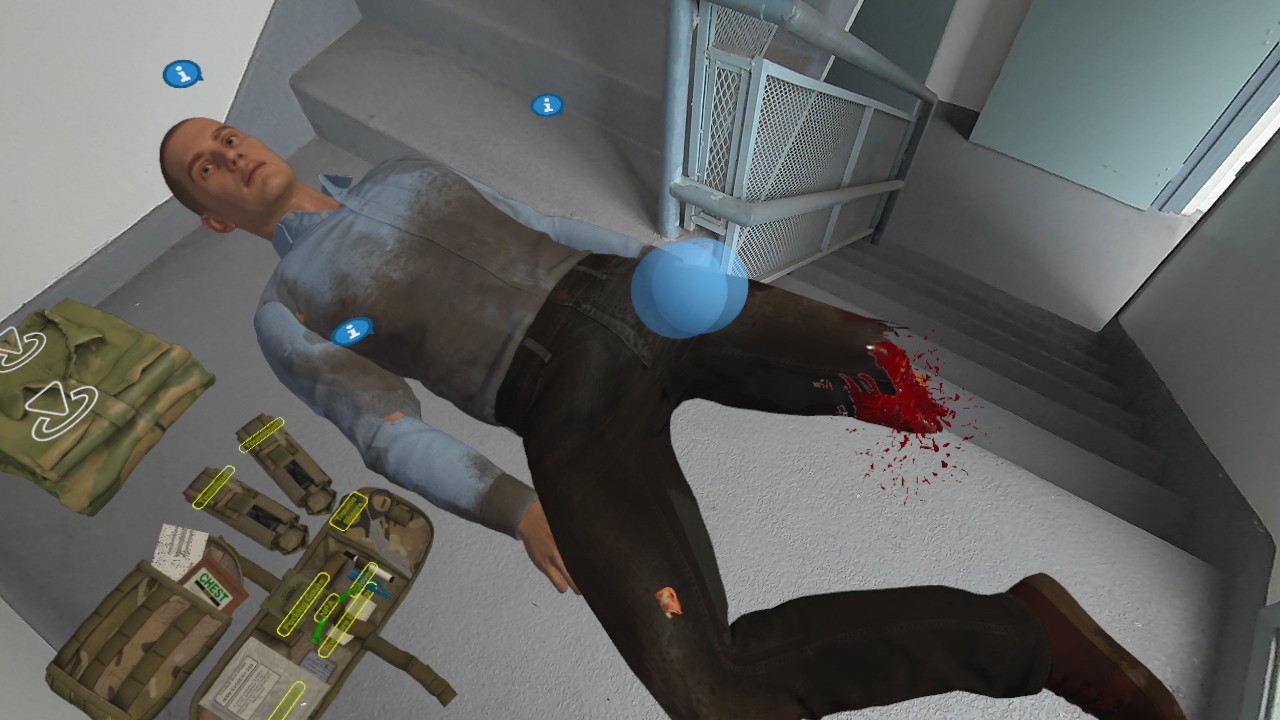
This is your first time taking care of Marcus Kane. The casualty was near a drone explosion about four minutes ago. You are now in a secure location. You already have personal protective equipment—gloves—on. No interventions have been performed yet. Your focus in this scenario is to learn how to control massive bleeding. This is one of the most time-critical and impactful steps in TCCC.
This scenario includes several informational comments that will frequently be presented in [Italics]. Informational comments do not require you to do anything directly in the simulator. Action-oriented comments that direct you to do something will be presented in [Bold] text.
Informational Step: This patient has multiple injuries—some require immediate treatment, some can wait. We will start by first identifying and treating life-threatening bleeding, using things like tourniquets, direct pressure, hemostatic gauze, and pressure dressings. Overall, your goal is to treat what’s going to kill the patient first – this starts with controlling massive hemorrhage.
The first step is identifying massive bleeding that can be treated with an extremity tourniquet. Do you see any injuries where a tourniquet is indicated? If yes, treat that injury if you know how to.
If you identified the left lower extremity (left leg) amputation and bleeding, good job! Stay calm and move quickly. If you haven’t treated the bleeding already, open an IFAK to get a tourniquet (use the patient’s IFAK if they have one). Otherwise, look down and use yours.
After opening the IFAK, grab the tourniquet and position it high and tight on the upper thigh, well above the bleeding site. Press the trigger to place the tourniquet, then press it again to tighten it. This patient’s bleeding should stop.
Informational Step: To place a tourniquet in real life, you would slide it under the leg, ensuring it's flat and not twisted. Secure the band snugly and pull the strap tight until two fingers CANNOT fit underneath the band. Then turn/twist the windlass until the bleeding stops. If one tourniquet is not effective, add a second.
Informational Step: Finally, in the field, you would write the time the tourniquet was placed either on the tourniquet itself or on the patient's forehead.
To mark the time a tourniquet was placed in the simulator, take the marker from the IFAK and bring it towards the tourniquet clasp. Pull the trigger. You will see the time appear.
Now, it’s time to perform a blood sweep to identify any additional life-threatening bleeding. Start at the head and work down. Put your controllers close to the patient's body (head, neck, arms, legs). You should see green text (no bleeding), yellow text (blood) or red text (active bleeding).
Informational Step: In real life, you would slide-and-check your hands along the patient’s neck, arms, legs, chest, back, armpits, and groin looking for evidence of blood or dampness.
If you find an area of active bleeding, assess the source, and apply the appropriate control method if you know how. Stay focused and be thorough; missed bleeding can be deadly. This patient has injuries with active bleeding. Can you find them?
The patient has severe bleeding in the groin area and on the patient’s left arm. First, let’s treat the groin wound, which is in a junctional zone where a traditional tourniquet can’t be applied. Stay focused and act quickly. Expose the groin wound and locate the source of bleeding. Use the shears to remove the patient’s clothes in that area.
Next, grab the packing gauze and pull the trigger near the wound to pack it. In real life, multiple rolls of the gauze may be required to pack the whole wound. You would take your hemostatic dressing and pack it tightly and deeply into the groin wound, directly over the bleeding site, while maintaining firm, constant pressure as you pack each layer.
Once the wound is fully packed, we must apply direct pressure for at least 3 minutes. Place your hand over the site and pull the trigger to apply direct pressure. If you lift your hand, even briefly, you must restart applying pressure.
Now that the wound is packed, and you have applied 3 minutes of direct pressure, the next step is to apply a pressure bandage over the wound. Grab the ‘Pressure Bandage’ and use it near the wound.
Informational Step: In real life, you must secure the pressure bandage tightly, ensuring consistent pressure over the site. You would also reassess for continued bleeding. If blood soaked through the bandage, you would not remove it; instead, apply an additional pressure bandage over the existing one.
Next, we will treat the laceration and bleeding on the patient’s left lower arm. Expose the wound (using shears) and assess the depth and source of bleeding.
Next, take packing gauze and pack it into the wound. In real life, you would press firmly against the point of maximum bleeding and continue packing the wound tightly, layer by layer, maintaining consistent pressure. Once the wound is fully packed, apply 3 minutes of direct pressure, then apply a pressure bandage over the packed area.
Informational Step: It could be debated whether a tourniquet or wound packing and direct pressure application would be optimal for the left lower arm wound. This is situation dependent. In this case, we suggest wound packing, applying 3 minutes of direct pressure, and a pressure bandage is best. Tourniquets save lives, but they do have risks such as limb ischemia, blood clots, and severe pain.
Do you see any other injuries on this patient?
The patient has a fracture in the right lower extremity, but there is no visible bleeding. Stay focused on the priority—massive hemorrhage. For now, do not spend time addressing the fracture. Continue your systematic assessment for life-threatening bleeding. Once all immediate threats to life are addressed, you will be able to return to the fracture site and provide additional treatment.
You may have identified a laceration on the patient’s right lower arm that is not actively bleeding. In the massive hemorrhage phase, your priority is to control life-threatening bleeding first—so for now, leave this laceration as is (no active bleeding) and continue your systematic assessment. Once you’ve addressed all critical bleeding sites and stabilized the casualty, you can return to the right arm laceration.
This concludes your scenario on Controlling Massive Bleeding/Hemorrhage. Next, open your tablet [X], select the disposition tab, and select Medical Evacuation to end your training scenario. After reviewing the feedback page, exit this simulation and select scenario 004 to continue.