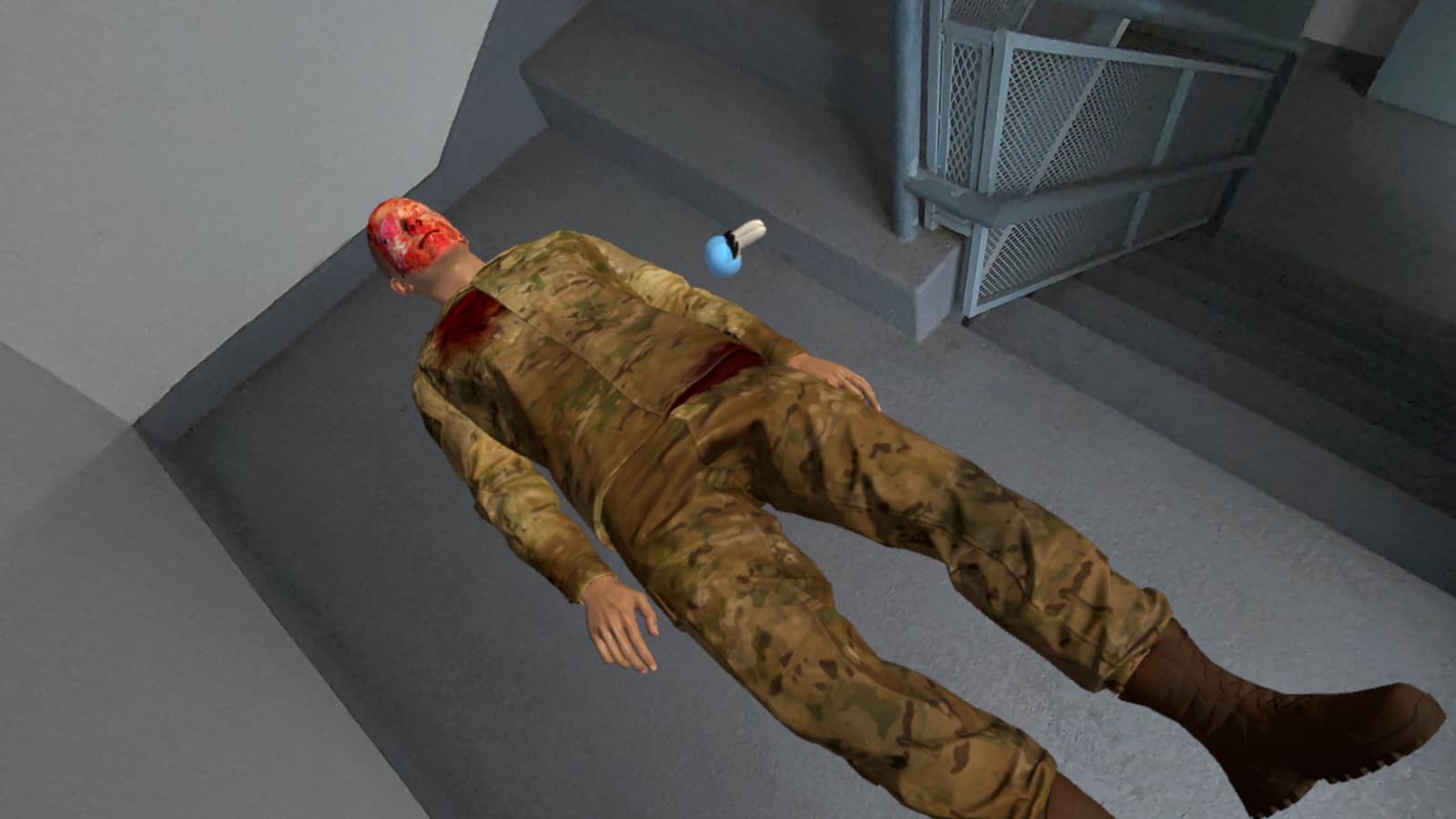
Tier 1 Practice Pack 010

You are providing care near the frontline. Once you have performed all life-saving interventions indicated for this phase of care, you can select [Disposition] in the tablet and select [Medical Evacuation to Higher Level of Care, Return to Duty, or Pronounce Dead], which will end your case. Note, unfortunately, just like in real life, it is not possible to save all patients. The treatment policy for THIS TRAINING ONLY is to pronounce a patient dead if there is no pulse for more than two minutes. In this combat theater, it is not possible to transfer a patient who requires active cardiopulmonary resuscitation.

Ongoing Development Disclaimer: In this package wording has not been updated to reflect new functionality to time and date tourniquets or for the non-adhesive burn bandage functionality. Additionally, it is possible other small updates or changes are not reflected in the wording. All grading is set to the current standard described in this package.

Patient Communication

Patient: Can you tell me your name?
Response: I think it's Robert? I don't actually remember and it's hard to talk.
Location: Head
Patient: Do you remember what happened?
Response: I think there was an explosion. Then gunfire.
Location: Head
Patient: Do you feel any pain?
Response: Yes. My chest, head, arms, leg, it's all killing me. Please help me.
Location: Head
Patient: Do you have any medical problems?
Response: No medical problems that I know of.
Location: Head
Patient: Do you have any allergies?
Response: No. I don't have any allergies that I know of.
Location: Head
Patient: Do you take any medications?
Response: No. I don't take any medications.
Location: Head
Patient: Are you feeling dizzy or confused?
Response: A little. It's getting hard to focus.
Location: Head
Patient: Are you having trouble breathing?
Response: It really hurts to breathe.
Location: Head
Patient: Can you see clearly?
Response: Everything seems a little blurry.
Location: Head
Patient: Do you feel any swelling in your throat?
Response: No. I think it's ok.
Location: Head
Patient: Are your lips or tongue swollen?
Response: No. I think they are doing ok.
Location: Head
Patient: Is your voice hoarse or different?
Response: It seems about the same as usual.
Location: Head

Audio Triggers

The system currently does not allow you to give this medication slowly in real life you would give over 5 to 10 minutes.
When performing this assessment, it is critical to avoid rocking the pelvis or putting any strain on the pelvis. The action you performed only checks for evidence of pelvic pain or gross instability. When in doubt, you can liberally place a pelvic binder.

Scoring Details

PPE: Blue Gloves (right side)
PPE: Blue Gloves (left side)
PPE: Blue Gloves (right side)
PPE: Blue Gloves (left side)
Exam: Assessment: Remove the patient's shirt
Exam: Assessment: Remove the patient's underpants
Exam: Assessment: Remove the patient clothing around left leg
Exam: Assessment: Remove the patient clothing around right leg
Exam: Assessment: Remove the patient clothing around left arm
Exam: Assessment: Remove the patient clothing around right arm
Exam: Assessment: Roll the patient over
Exam: Assessment: Roll the patient back
Exam: Assessment: Roll the patient over
Exam: Assessment: Roll the patient back
Exam: Assessment: Remove the patient's shirt
Exam: Assessment: Remove the patient's underpants
Exam: Assessment: Remove the patient clothing around left leg
Exam: Assessment: Remove the patient clothing around right leg
Roll patient into recovery position
Blood Sweep (left lower thigh) (Left Leg Ampute)
Blood Sweep (right arm) (Deep Wound Arm Right)
Blood Sweep (groin)
Blood Sweep (right upper thigh) (Open Fracture / Open Fracture Blood / Shrapnel Leg Right)
Blood Sweep (right lower thigh) (Right Leg Ampute)
Blood Sweep (left upper arm) (Left Arm Ampute / Shrapnel Arm Left)
Blood Sweep (right upper arm) (Right Arm Ampute / Shrapnel Arm Right)
Blood Sweep (left arm) (Deep Wound Arm Left)
Blood Sweep (left lower leg) (Deep Wound Leg Left)
Blood Sweep (right lower leg) (Deep Wound Leg Right)
Blood Sweep (left upper thigh) (Left Leg Ampute / Shrapnel Leg Left)
Blood Sweep (right chest, front) (Gunshot Wound Chest Right)
Blood Sweep (left chest, front) (Gunshot Wound Chest Left)
Blood Sweep (right chest, back) (Gunshot Wound Back Right)
Blood Sweep (stomach) (Shrapnel)
Massive Hemorrhage: Place Tourniquet on Left Lower Thigh
Place bandage on the right lower arm (deep wound)
Apply pressure to right arm
Place bandage on the right lower arm (deep wound)
Apply pressure to right arm
Place bandage on the left groin
Apply pressure to groin
Place bandage on the left groin
Exam: Ask patient
Airway: Jaw thrust maneuver
Listen for breathing
Exam: Assessment: Check Carotid Pulse Right
Exam: Assessment: Check Carotid Pulse Left
Exam: Assesment: Check Radial Pulse Right
Exam: Assesment: Check Radial Pulse Left
Exam: Assesment: Check Femoral Pulse Right
Exam: Assesment: Check Femoral Pulse Left
Exam: Assesment: Check Pedial Pulse Right
Exam: Assesment: Check Pedial Pulse Left
Lift right eyelid
Lift left eyelid
Lift right eyelid
Lift left eyelid
Exam: Ask patient to move right leg
Exam: Ask patient to move left leg
Exam: Ask patient to move right arm
Exam: Ask patient to move left arm
Exam: Ask patient
Hypothermia Management: Place Blanket
Hypothermia Management: Put Back All Clothes
Hypothermia Management: Put Back Shirt
Hypothermia Management: Put Back Pants Left Leg
Hypothermia Management: Put Back Pants Right Leg
Hypothermia Management: Put Back Underpants
Hypothermia Management: Put Back Underbra
Send 9-liner
Exam: Assessment: Complete TCCC card
Patient disposition: Medical Evacuation

Scenario Details

Scenario Package
TCCC Tier 1 Practice Pack
Learner type
  • militaryMedic
Patient severity at start
Serious
Patient severity overall
Serious
Duration to complete
<5 minutes
Scenario difficulty
Challenging
Environment
POI
Equipment
  • bandage
  • Duct Tape
  • Combat Application Tourniquet
  • Combat Application Tourniquet
  • Trauma Shears
  • FoilBlanket
  • Blanket
  • ChestSealPackage
  • AlcoholWipe
  • PackingGauze
  • Gloves box
  • Eye Guard
  • Marker
  • Non-Adherent Dressing
  • Decompression needle
  • TCCC Card
Available medications
Injury type
  • Amputated left leg at knee
  • Bruise behind right ear
  • Chest wound (anterior left)
  • Deep wound on the right arm
  • Eye cornea trauma, left side
  • Groin junctional wound, left side
  • Jugular vein, right side
  • Open fracture of the right thigh with visible bone
Pathologies
  • external hemorrhage, right arm
  • pneumothorax, open, left
  • external hemorrhage, left kidney
  • external hemorrhage, left leg
Scoring summary
  • PPE
  • M-Exposure
  • M-Blood Sweep
  • M-Place Tourniquet
  • M-Treat Laceration
  • M-Treat Groin Wound
  • A-Assess Airway
  • C-Check Peripheral/Central Pulse
  • H-Assess Pupils
  • H-Assess for Neurologic Deficit
  • H-Hypothermia Management
  • Communicate with team
  • Documentation
  • Disposition