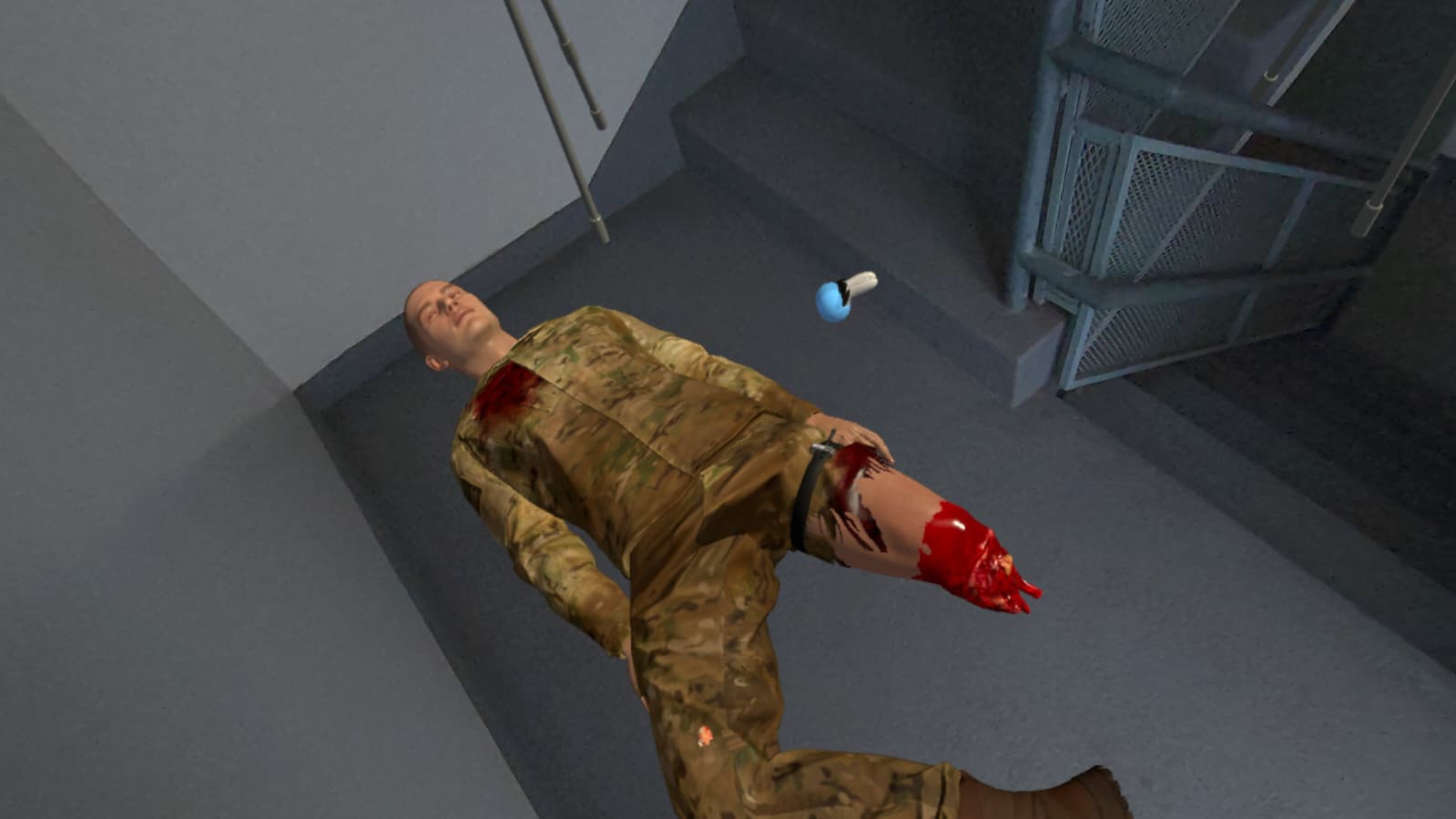
This is the second scenario in the Tier 2/Combat Life Saver curriculum pack. The following scenarios will provide training on additional TCCC at the Tier 2 Level. There are new interventions in the Airway, Respirations, Circulation, Head Injury, Hypothermia, and Fracture portions of TCCC. Additionally, Tier 2 introduces you to new medications that can be used for pain as well as infection prevention and treatment. We will proceed sequentially through MARCH.
Tier 2 Airway Treatments (NPA and BVM): You are in a SAFE and SECURE location – The primary learning objective is to show you another more advanced way to treat an airway obstruction using a nasopharyngeal (NPA) airway device in combination with a Bag Valve Mask (BVM) Device. The estimated time to complete this scenario is 5 minutes. This scenario occurs in the Tactical Field Care Phase. Equipment Available: Combat Life Saver Pack. Evacuation/Disposition is possible through the tablet. Selecting the patient’s disposition will end the exercise.
Patient Communication
Patient: Can you tell me your name?
Response: This patient's breathing is noisy and they are having difficulty talking
Location: Head
Patient: Do you feel any pain?
Response: This patient's breathing is noisy and they are having difficulty talking
Location: Head
Patient: Do you have any medical problems?
Response: This patient's breathing is noisy and they are having difficulty talking
Location: Head
Patient: Do you have any allergies?
Response: This patient's breathing is noisy and they are having difficulty talking
Location: Head
Patient: Do you take any medications?
Response: This patient's breathing is noisy and they are having difficulty talking
Location: Head
Patient: Are you feeling dizzy or confused?
Response: This patient's breathing is noisy and they are having difficulty talking
Location: Head
Patient: Are you having trouble breathing?
Response: This patient's breathing is noisy and they are having difficulty talking
Location: Head
Patient: Can you see clearly?
Response: This patient's breathing is noisy and they are having difficulty talking
Location: Head
Patient: Do you feel any swelling in your throat?
Response: This patient's breathing is noisy and they are having difficulty talking
Location: Head
Patient: Are your lips or tongue swollen?
Response: This patient's breathing is noisy and they are having difficulty talking
Location: Head
Patient: Is your voice hoarse or different?
Response: This patient's breathing is noisy and they are having difficulty talking
Location: Head
Patient: Do you remember what happened?
Response: This patient's breathing is noisy and they are having difficulty talking
Location: Head
Guided Steps
The patient was injured in a blast from a drone attack about 30 minutes ago and other soldiers dragged them to your location. You already washed your hands, put on your gloves, and did a search for massive hemorrhage which was normal. Next, perform an airway assessment. What is this patient's airway exam? Press and hold [B] to proceed to the next step.
The patient is not able to talk and has harsh breathing sounds called stridor that can be heard if you put your head close to the patient's face and mouth. Next, perform an initial airway maneuver to try treating the patient’s airway obstruction. Press and hold [B] to proceed to the next step.
If you tried a jaw thrust or head tilt chin lift or rolling the patient into the recovery position then good job! Next, reassess the patient’s airway to see if this helped or fixed the obstruction.
The patient still has stridor, which means the airway is still obstructed. Next, we need to place a nasopharyngeal airway. Open your Combat Life Saver Pack and find the curved tube labeled nasopharyngeal airway N P A. pick it up, measure it to ensure it is the right size, then place it.
Next, reassess the patient’s airway to see if this helped or fixed the obstruction.
The patient still has harsh breathing sounds called stridor that can be heard if you put your head close to the patients face and mouth. What else can we do for the patient to help treat the airway obstruction?
If you said to use a Bag Valve Mask Ventilator (BVM) good job! Look inside your Combat Life Saver Pack to find the BVM. The BVM is a large blue bag with a clear mask on the end. Hold the BVM in your right hand, stand over the patient’s head, then place the mask over the patient's mouth with the more pointy part of the mask covering the patient's nose. Then pull the [TRIGGER] to deliver a breath, you will see the patient’s chest rise and fall.
Informational Step: In real life you need to work hard to get a good ‘seal’ between the mask and the patient’s face. This is often obtained using what is called the E C technique. Where you use your non dominate hand to hold the mask to the patient's face with your thumb and pointer finger (creating a C on top of the mask), and then use your middle, ring, and pinky finger (forming an E) to lift the jaw up into the mask. This skill is critical to practice on a physical manikin if one is available.
Next, it is essential to help the patient breathe with the BVM by squeezing about half of the bag (or just until you see the chest rise) and administering a breath approximately every 6 seconds at a rate of approximately 10 breaths per minute. This requires a dedicated person to do, so in real life, you would need to seek help in taking care of this patient to complete the rest of the M A R C H exam.
This concludes your scenario. Next, open your tablet [X], select the disposition tab, and select Medical Evacuation.
