
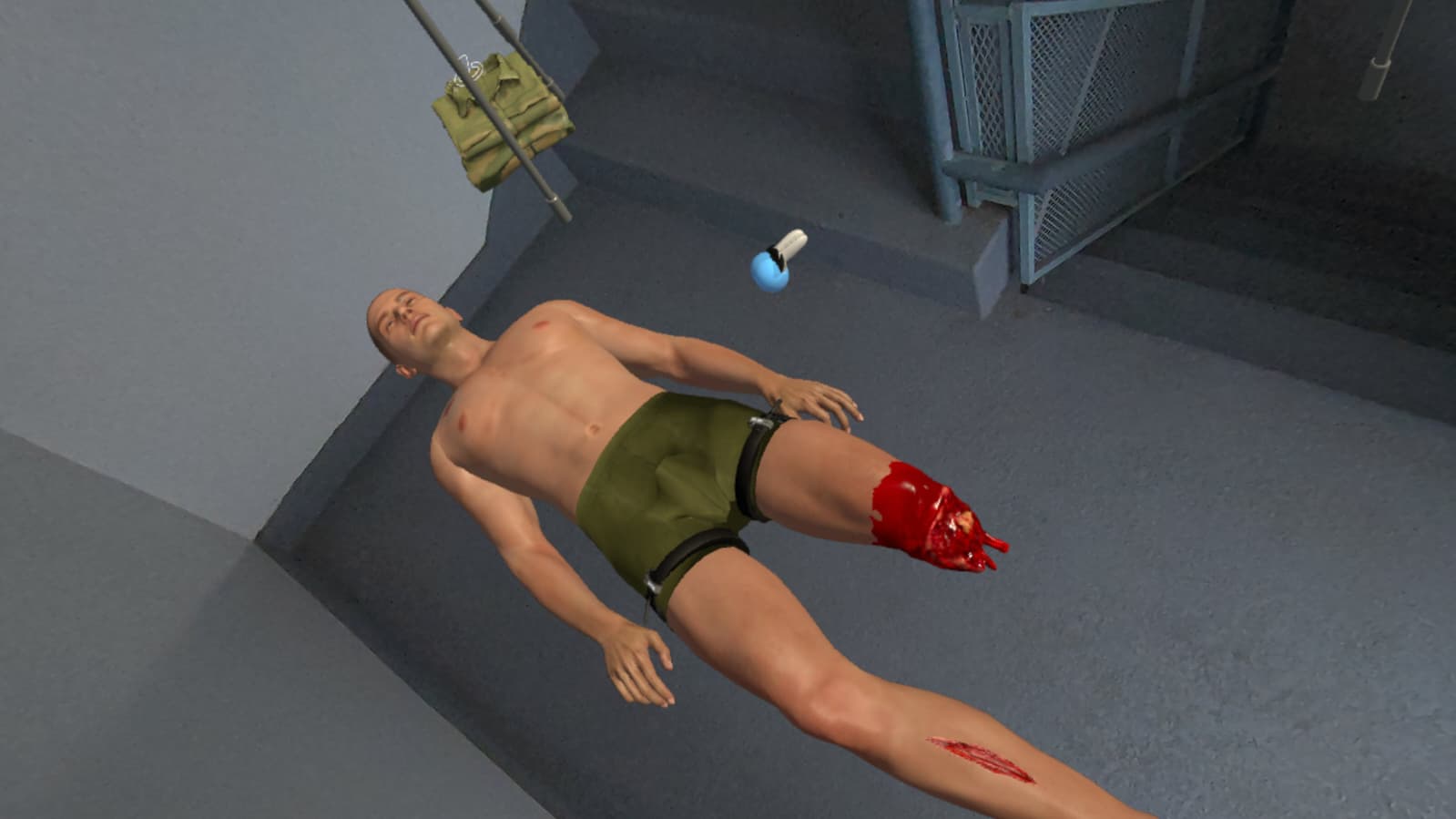
Ви надаєте допомогу поблизу лінії фронту. Після того, як ви виконаєте всі життєво необхідні втручання, передбачені для цього етапу догляду, ви можете обрати [Розподіл] на планшеті та вибрати [Медична евакуація на вищий рівень допомоги, Повернення до служби або Констатація смерті], що завершить ваш випадок. Зверніть увагу: на жаль, так само як і в реальному житті, врятувати всіх пацієнтів неможливо. Політика лікування ТІЛЬКИ ДЛЯ ЦЬОГО НАВЧАННЯ передбачає констатацію смерті пацієнта, якщо відсутній пульс понад дві хвилини. У цьому бойовому районі неможливо перевести пацієнта, який потребує активної серцево-легеневої реанімації.
Patient Communication
Patient: Can you tell me your name?
Response: I think it's Robert?
Location: Head
Patient: Do you remember what happened?
Response: There was an explosion. Everyone ran.
Location: Head
Patient: Do you feel any pain?
Response: Yes. I hit the ground.
Location: Head
Patient: Do you have any medical problems?
Response: No. I don't think I have any medical problems.
Location: Head
Patient: Do you have any allergies to medications?
Response: No. I don't have any allergies to medications.
Location: Head
Patient: Do you take any medications?
Response: No. I don't take any medications.
Location: Head
Patient: Are you feeling dizzy or confused?
Response: I'm feeling a little dizzy.
Location: Head
Patient: Are you having trouble breathing?
Response: No. I can breathe normally.
Location: Head
Patient: Can you see clearly?
Response: Yes. I can see clearly.
Location: Head
Patient: Do you feel any swelling in your throat?
Response: No. My throat feels normal.
Location: Head
Patient: Are your lips or tongue swollen?
Response: No. I don't think so.
Location: Head
Patient: Is your voice hoarse or different?
Response: I think it's sounds normal.
Location: Head
Patient: Have you ever had a reaction to antibiotics?
Response: No. I have not.
Location: Head
Guided Steps
This patient was injured in a blast from a drone attack about 45 minutes ago. Other soldiers eventually placed a tourniquet to a left leg amputation and dragged them to your location.
You already washed your hands, put on your gloves, and did a search for massive hemorrhage, which was normal while noting the functioning tourniquet. The patient's airway is clear. You assessed the patient’s chest and found an open chest wound but no obvious pneumothorax. You placed a chest seal. You tried to take the tourniquet down, but bleeding resumed. A lower tourniquet is not possible in this simulator, but is considered to have been done. The patient responds to voice but likely has a mild closed head injury. You prevented hypothermia and adminstered acetaminophen and meloxicam.
Next, look through the medication pouch. What medication do you have that is a typical Tier 2 TCCC antibiotic?
If you said Moxifloxacin, good job! Next we will review several important aspects about this medication.
Informational Step: What Is Moxifloxacin? Moxifloxacin is a powerful broad-spectrum antibiotic in most Combat Wound Medication Packs. Each medication pack usually contains one 400 mg tablet. It prevents infection in contaminated combat wounds by killing bacteria before they can establish an infection. Moxifloxacin has excellent tissue penetration, including outstanding penetration into the eye for penetrating eye injuries.
Informational Step: When To Use Moxifloxacin. Give moxifloxacin to all casualties with open combat wounds regardless of injury type. This includes gunshot wounds, blast injuries, shrapnel wounds, open fractures, amputations, and penetrating eye injuries. Administer it as soon as possible after injury when the casualty can swallow. Early antibiotic administration is critical for preventing wound infections in the combat environment.
Informational Step: When NOT To Use Moxifloxacin. The only true contraindication is a known severe allergy to fluoroquinolone antibiotics like Cipro, Levaquin, or Avelox. Ask if the casualty has ever had a bad reaction to these antibiotics. If the casualty cannot swallow, is unconscious, or in shock, use an alternative antibiotic available from higher TCCC tier providers.
Informational Step: How To Give Moxifloxacin. Have the casualty swallow the 400 mg tablet with water. It can be taken with or without food. Give as early as possible after injury. If available, use the casualty's own medication pack for the first dose to preserve unit supplies.
Informational Step: Dosing And Timing. Give 400 mg by mouth once daily. The first dose should be given as soon as possible after identifying an open combat wound. Continue daily dosing until the casualty receives surgical care and debridement. Do not delay antibiotic administration. Time is critical because effectiveness decreases the longer you wait after injury occurs.
Informational Step: What To Expect. Moxifloxacin is very well tolerated with minimal side effects in short-term combat use. The casualty may experience mild nausea or diarrhea but can usually continue the mission. There is no sedation, confusion, or impaired judgment. The goal is infection prevention, not treatment, so you should not see signs of infection if the antibiotic works properly.
Informational Step: Key Advantages. Moxifloxacin covers a broad spectrum of bacteria including gram-positive, gram-negative, and anaerobic organisms commonly found in combat wounds. It has exceptional eye penetration, making it ideal for penetrating eye injuries. Once-daily oral dosing is simple and effective. Combat data shows early antibiotics dramatically reduce infection rates even with prolonged evacuation delays.
Informational Step: Monitoring The Casualty. Check that the casualty tolerates the medication, while rare potential side effects include dizziness, headache, peripheral neuropathy, nausea, diarrhea, abdominal pain, vomiting, taste perversion, abnormal liver function tests, dyspepsia, and tendon rupture.
Informational Step: Documentation Requirements. Write on the TCCC Card: Moxifloxacin 400 mg PO with the time of administration. Note the wound type that required antibiotics. If giving subsequent daily doses, record each dose with the date and time. Clear documentation prevents duplicate dosing and guides receiving facilities.
Informational Step: Common Mistakes To Avoid. The biggest mistake is delaying or forgetting antibiotic administration while focusing only on hemorrhage and pain control. Do not give to casualties with fluoroquinolone allergies. Never give to K-9 casualties. Do not forget to document on the TCCC Card. Remember that moxifloxacin must be given as soon as possible for maximum effectiveness.
Next, ask the patient if they have any allergies to medications.
Next, give the patient the appropriate dose of Moxifloxacin by picking up the tablet, placing near the patients mouth and pulling the [TRIGGER].
Pick up the TCCC card to document the Moxifloxacin dose you administered to the patient.
This concludes your scenario. Next, open your tablet [X], select the disposition tab, and select Medical Evacuation.