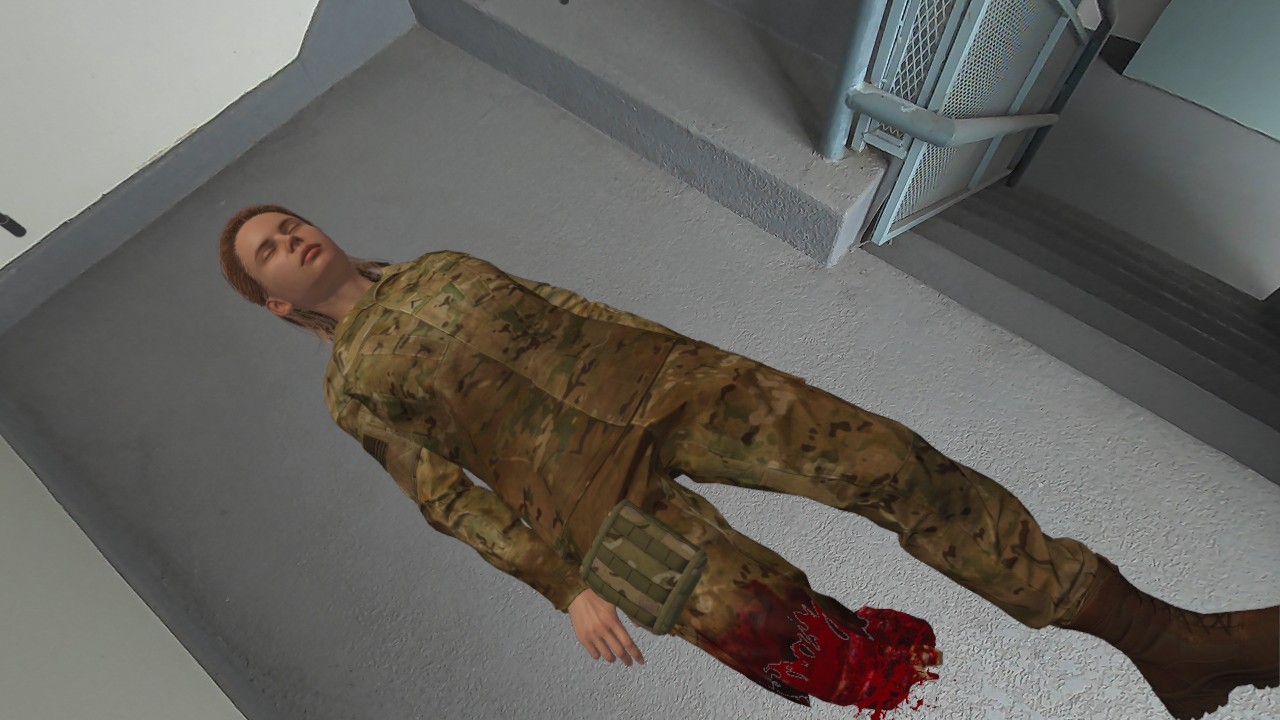
ASM 001

Seconds to Save a Life: Why TCCC Matters – Tier 1 – You are in a SAFE and SECURE location – The primary learning objective is to show you how quickly traumatic injuries can kill a person, and to provide an overview of Tactical Combat Casualty Care (TCCC). The estimated time to complete this scenario is 5 minutes. This scenario occurs in the Tactical Field Care Phase. Equipment Available: None. Evacuation/Disposition is possible through the tablet. Selecting the patient’s disposition will end the exercise. (Scenario 001)

DISCLAIMER/WARNING: For some people witnessing a patient die (even if virtual) can be triggering and cause feelings of stress, anxiety, and other powerful responses. If this concerns you, please STOP and discuss the best way to proceed with your facilitator.

Dynamic Physiology Disclaimer:
To obtain the most accurate and effective training experience, we recommend completing each scenario in one uninterrupted session. The virtual patients used in this training are powered by highly realistic physiological models that continuously adjust vital signs and overall condition. The scenarios have been modified to give you time to review instructional materials, and you will not lose points for delays in scenarios with instructional content. However, it is still possible that, depending on your completion pace, the scenario may not progress in perfect alignment with the guided prompts, and for critically injured patients, even moderate delays may result in deterioration or death before the scenario concludes. This is not meant to indicate you did not perform well; rather, it is because of how the high-fidelity engine performs.

Ongoing Development Disclaimer: In this package wording has not been updated to reflect new functionality to time and date tourniquets or for the non-adhesive burn bandage functionality. Additionally, it is possible other small updates or changes are not reflected in the wording. All grading is set to the current standard described in this package.

Patient Communication

Patient: Hey, I am here to take care of you.
Response: The patient is unable to respond.
Location: Head
Patient: Can you tell me your name?
Response: The patient is unable to respond.
Location: Head
Patient: What happened?
Response: The patient is unable to respond.
Location: Head
Patient: Are you hurting anywhere?
Response: The patient is unable to respond.
Location: Head
Patient: Does your throat hurt or feel tight?
Response: The patient is unable to respond.
Location: Head
Patient: Are you having a hard time breathing?
Response: The patient is unable to respond.
Location: Head
Patient: Does your chest hurt?
Response: The patient is unable to respond.
Location: Head
Patient: Did you pass out (lose consciousness)?
Response: The patient is unable to respond.
Location: Head
Patient: Do you have any numbness or weakness?
Response: The patient is unable to respond.
Location: Head
Patient: Does your head hurt?
Response: The patient is unable to respond.
Location: Head
Patient: Does your neck hurt?
Response: The patient is unable to respond.
Location: Head
Patient: Does your back hurt?
Response: The patient is unable to respond.
Location: Head
Patient: Does your abdomen hurt?
Response: The patient is unable to respond.
Location: Head
Patient: Do you have any allergies?
Response: The patient is unable to respond.
Location: Head
Patient: Do you take any medications?
Response: The patient is unable to respond.
Location: Head
Patient: Do you have any medical problems?
Response: The patient is unable to respond.
Location: Head
Patient: Have you ever had any surgeries?
Response: The patient is unable to respond.
Location: Head
Patient: When did you last eat or drink something?
Response: The patient is unable to respond.
Location: Head
Patient: Do you smoke, drink, or use recreational drugs?
Response: The patient is unable to respond.
Location: Head
Patient: Tell the patient what you are going to do.
Response: The patient is unable to respond.
Location: Head
Patient: Tell the patient you are going to take care of them.
Response: The patient is unable to respond.
Location: Head

Guided Steps

Private Mia Carter was injured by a drone explosion two minutes ago. She will die in about two minutes. We will not treat Mia in this scenario, so you can see how quickly these injuries can kill. Put your hand on the right or left side of Mia’s neck to check her carotid pulse. Mia has external bleeding, an airway obstruction, and a tension pneumothorax. Next, select the [Advance Arrow] on the Guidance Panel or press and hold [B] to proceed.
Informational Step: On the battlefield, most preventable deaths come from just three injuries: Massive bleeding from extremity wounds, airway obstruction, where swelling or injuries block breathing, or a tension pneumothorax, where trapped air compresses the lungs and heart. Press and hold [B] to proceed
As you watch Private Carter’s condition worsen (continue to check her carotid pulse), remember that the right actions at the right time can save patients like Mia. This course will review TCCC tier 1 principles that save lives. Your training starts here. Press and hold [B] to proceed
Once the patient's heart rate goes to 'Zero' and she stops breathing, open your tablet [X], select the [Disposition] tab, and select [Pronounce dead] to end this scenario. This concludes your introduction scenario 001. Next, we will work through MARCH using new training patients for each section, starting with 002.
You will continue through all scenarios chronologically. You will see three patients repeatedly, and you will ultimately take care of those three patients without guidance to complete the course. Next, open your tablet [X], select [End Simulation], and select [Exit Simulation]. This will take you back to the lobby, where you should select Single User, then select scenario 002 to continue.

Scenario Details

Scenario Package
TCCC Tier 1 Curriculum
Learner type
  • militaryMedic
Patient severity at start
Critical
Patient severity overall
Critical
Duration to complete
<5 minutes
Scenario difficulty
Standard
Environment
POI
Equipment
  • Bandage
  • Combat Application Tourniquet (1)
  • Combat Application Tourniquet (2)
  • Trauma Shears
  • Blanket
  • FoilBlanket
  • Nasopharyngeal airway
  • Chest Seal Package
  • Packing Gauze
  • Gloves
  • Eye Guard
  • Non-Adherent Dressing
  • Medication Pouch
  • Radio
  • Marker
  • Triage Tag (Minimal)
Available medications
  • Acetaminophen Pills
  • Moxifloxacin 1 g
  • Meloxicam 15mg
Injury type
  • Abdominal internal bleeding
  • Airway obstruction
  • Amputated right leg below knee
Pathologies
  • pneumothorax, open, right
  • airway obstruction
  • external hemorrhage, right leg
  • internal hemorrhage, vena cava
Scoring summary
  • C-Check Peripheral/Central Pulse
  • Disposition